
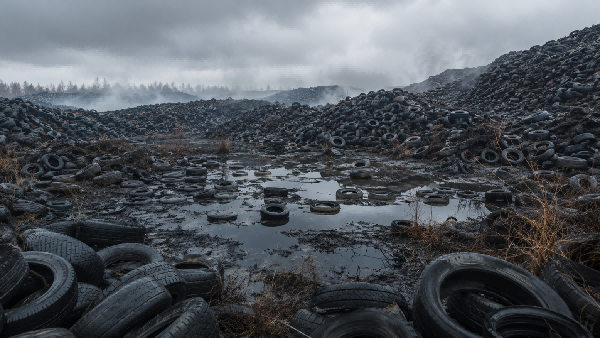
Waste tires, widely referred to as “black pollution,” now exceed 15 billion units generated globally each year, with disposal pressure mounting continuously. The industry is shifting from traditional low-efficiency handling toward high-value resource recovery, and waste rubber pyrolysis—with its high recovery rate, minimal secondary pollution, and high-value by-products—has become the globally recognized technology pathway for the future of tire recycling.
According to 2026 data released by Business Research Insights, the global tire pyrolysis plant market has reached USD 1.97 billion, projected to grow to USD 3.84 billion by 2035 at a CAGR of 7.7%. More than 700 industrial-scale pyrolysis units are now in operation worldwide, with Asia accounting for over 45% of installed capacity. On the equipment side, 68% of newly built plants have adopted continuous pyrolysis systems, and 55% integrate automated control technology—confirming continuous, large-scale, and intelligent operation as the dominant direction of global tire pyrolysis equipment upgrades.
Traditional batch pyrolysis units suffer from structural limitations: single-batch processing, manual loading/unloading, and low thermal efficiency, resulting in small per-line capacity, high energy consumption, and unstable product quality—none of which meet the demands of large-scale, continuous industrial production. Continuous pyrolysis technology resolves these pain points through process and equipment innovation:
First, a leap in processing capacity. Continuous feeding and discharging deliver a single-line daily throughput 3–5 times that of batch units, fundamentally breaking the capacity bottleneck and providing the equipment foundation for bulk waste tire disposal.
Second, structural optimization of operating costs. Through integrated waste heat recovery and non-condensable gas recycling, continuous units achieve thermal self-sufficiency, cutting energy consumption per ton by 25%–30% versus batch processes. Automated control further reduces labor dependence, bringing total operating costs down by more than 30%.
Third, stable and controllable product quality. Under continuous operation, key parameters—reaction temperature, residence time, material ratios—are precisely controlled. Tire pyrolysis oil has evolved from a single fuel-oil output into a feedstock for chemicals, renewable fuels, and other high-value applications.
With more than 30 years of focus on pyrolysis, Niutech has driven industry upgrades through continuous innovation. In April 2026, the company officially launched a new generation of large-capacity industrial continuous intelligent pyrolysis equipment, achieving breakthroughs across four dimensions: single-unit capacity, operating efficiency, cost control, and product quality. In May 2026, Niutech showcased customized pyrolysis solutions for over 30 types of organic waste—including waste tires—at IFAT 2026 in Munich, Germany, earning strong recognition from customers across Europe, the Americas, and the Middle East. Going forward, Niutech will continue to drive industry progress with continuous, large-scale, and intelligent equipment technology, delivering one-stop waste tire pyrolysis solutions covering process design, equipment manufacturing, and engineering delivery, and supporting the high-quality development of the global circular economy.