
Scrap tires are among the most difficult bulk solid wastes to degrade, widely known as “black pollution.” The stable three-dimensional cross-linked structure of vulcanized rubber means natural decomposition takes hundreds of years. Over 20 million tonnes of scrap tires are generated globally every year. Traditional disposal methods such as landfilling, open stockpiling, or direct incineration not only occupy land, release harmful gases and heavy metals, and create fire hazards, but also waste recyclable resources, including rubber, carbon black, and steel.
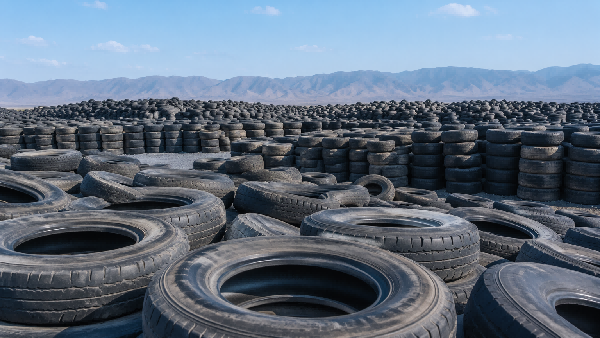
Scrap tire pyrolysis, as a mature technology route for chemical recycling via pyrolysis, is emerging as a key solution for global rubber recycling and waste-to-energy applications. The process takes place in a sealed, oxygen-free or low-oxygen environment, where precisely controlled heating breaks down the large molecular chains of tire rubber into three categories of recyclable products.
Pyrolysis oil accounts for 40–45% of output, with a calorific value close to conventional diesel. It can be used directly as industrial fuel for waste-to-energy scenarios, or further refined as feedstock for refineries to produce sustainable fuels or basic chemicals. Recovered carbon black (rCB) makes up 35–40% of solid output, and after upgrading, can be reused in tire manufacturing, rubber products, or as a substitute for industrial carbon black, enabling closed-loop rubber recycling. The remaining 10–15% is non-condensable combustible gas, primarily composed of methane, hydrogen, and carbon monoxide. This gas is directly fed back to the combustion system to heat the pyrolysis line itself, achieving energy self-sufficiency; surplus gas can also be used for power generation or external heating, further improving overall waste-to-energy efficiency. Steel wire separated during processing is directly sent for steel recycling.
Compared to traditional disposal routes, scrap tire pyrolysis delivers dual value: energy recovery and material circularity. Dioxin emissions during pyrolysis are far lower than from incineration, all outputs are fully utilized, and full resource recovery of scrap tires is achieved. A large-scale continuous pyrolysis line can reach tire resource utilization rates above 99%, reducing carbon emissions by more than 70% compared to conventional incineration. Across the tire recycling business sector, commercial adoption is accelerating rapidly: leading tire manufacturers have set targets for 40% renewable material content in tires by 2030, and rCB as a stable recycled feedstock is being integrated into long-term procurement systems of global tire majors. Pyrolysis oil, as a green fuel and chemical feedstock, is also drawing sustained attention from the energy and chemical industries.
Early tire recycling business projects mostly relied on batch pyrolysis equipment, which came with well-documented limitations: repeated startup and shutdown cycles, inconsistent product quality between batches, unstable compliance with environmental emissions standards, high labor costs, and difficulty scaling to large continuous operations — all of which constrained commercial rollout. The maturity of continuous scrap tire pyrolysis technology has addressed these industry-wide pain points. Core technologies, including dynamic sealing, precision temperature control, and intelligent coordinated control enable year-round uninterrupted stable operation, consistent uniform product quality, controlled emissions, lower unit energy consumption, and significantly improved economics, providing reliable equipment support for large-scale rubber recycling project deployment.
As a long-established supplier of continuous pyrolysis equipment for organic waste, Niutech’s complete continuous scrap tire pyrolysis plants have been deployed in multiple tire recycling projects at home and abroad. The equipment adapts to scrap tire feedstocks of different sources and specifications, producing pyrolysis oil and rCB of stable quality suitable for both downstream deep processing and waste-to-energy applications. Non-condensable gas is fully recycled for process heating, with waste heat recovery efficiency above 90%, helping clients meet environmental compliance targets while generating stable resource recovery revenue. As global demand for waste-to-energy and chemical recycling pyrolysis continues to grow, continuous scrap tire pyrolysis is delivering a scalable disposal path for “black pollution” that balances environmental benefits with economic returns, supporting the long-term development of the rubber recycling industry and circular economy.