
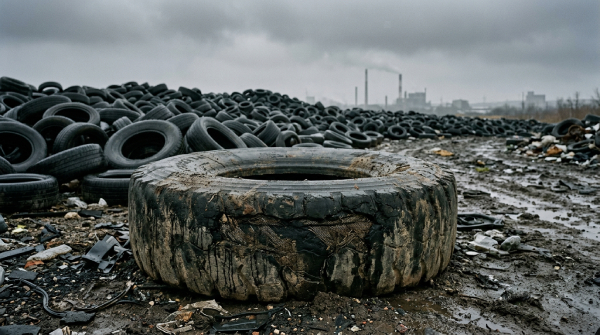
Every year, more than five million end-of-life tires are generated in Europe and the United States, and this number continues to grow annually. Millions of scrap tires are piled up in landfills and idle sites, occupying valuable land resources, increasing fire risks, breeding mosquitoes, and causing potential pollution to soil and groundwater. As environmental regulations become increasingly strict worldwide, traditional disposal methods such as landfilling, incineration, and stockpiling are no longer sustainable. The industry is urgently looking for more sustainable solutions for scrap tire recycling.
Currently, various scrap tire treatment technologies exist in the market, each with its own application scenarios, but also obvious limitations. Physical crushing can process scrap tires into rubber granules for sports fields and road construction, but the market capacity is limited and cannot absorb the huge amount of waste tires added every year. Traditional batch waste rubber pyrolysis can convert scrap tires into fuel oil, but it has low production capacity, high labor costs, unstable production process, and fluctuating oil quality, making it difficult to meet the demand of large-scale industrial processing.
The modern industrial continuous tire pyrolysis process operates automatically in a closed system from raw material pretreatment to final product output. After crushing, raw materials are continuously fed into the pyrolysis reactor, completing the pyrolysis reaction under constant temperature and negative pressure environment. The produced oil gas is fractionated into fuel oil and combustible gas, while steel wire and carbon black are collected and recovered separately. Compared with traditional batch processes, the continuous tire pyrolysis process increases production efficiency several times, reduces operator requirements, and delivers more stable and safe operation.
Through scientific pyrolysis technology, we not only solve the environmental problems caused by scrap tires, but more importantly, convert waste into usable resources. Waste tires contain a large amount of organic matter, and through pyrolysis treatment, we can obtain high-quality fuel oil. These oil products can be widely used in industrial fields, truly realizing the resource circulation of tire to oil. The combustible gas generated during production can be reused as fuel, reducing external energy consumption, and carbon black powder can also be further processed and utilized, with almost no waste discharge.
Against the global background of energy transition and carbon neutrality, waste to energy has become an important direction for circular economy development in many countries. The various wastes we generate every day actually contain a lot of energy. Through mature pyrolysis technology, this “garbage” that would otherwise be landfilled can be converted into usable energy. For high-calorific-value organic waste like scrap tires, pyrolysis treatment kills two birds with one stone: it solves environmental problems and produces energy, creates economic benefits, and fully conforms to the development concept of the circular economy.
As a global leading supplier of industrial continuous low-temperature pyrolysis technology, NIUTECH has been deeply engaged in this field for more than 30 years, with complete independent intellectual property rights and multiple patents. Our waste rubber pyrolysis production lines have been successfully operated in multiple countries, helping customers process millions of tons of scrap tires and won wide market recognition. Our projects have obtained ISCC EU/PLUS dual international certification, which can meet the sustainable material certification requirements of European and American markets and help customers better comply with local environmental regulations.
As global attention to environmental protection and resource recycling increases, the scrap tire recycling industry is undergoing a technological upgrading transformation. With its advantages of large-scale production, automation, and high efficiency, continuous waste rubber pyrolysis is gradually replacing traditional processes and becoming the new mainstream of industry development. We believe that under the general trend of waste to energy, this technology will help more countries solve scrap tire treatment problems and truly achieve a win-win situation between environmental benefits and economic benefits.